
Investing in a shooting arcade machine requires more than just looking at the flashy cabinet lights or the game title.
For arcade operators, the real value lies in the engineering precision that ensures long-term profitability and minimal downtime.
High-traffic environments demand hardware that can withstand thousands of interactions daily while maintaining a responsive user experience.
Modern shooting simulators have evolved from simple light-gun games into complex hardware systems that integrate high-definition displays with precise tracking technology.
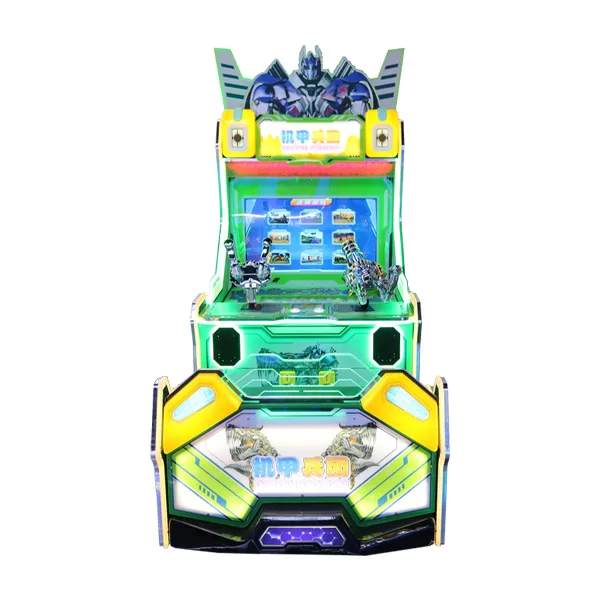
The 42-inch Mech Corps Shooting Arcade Game Machine serves as a prime example of this industrial evolution.
It utilizes a large-format 42-inch HD screen that provides the visual density required for modern monster-defeat and boss-challenge scenarios.
A key technical challenge in these machines is the latency between the physical trigger pull and the on-screen action.
Low-latency control boards are essential to ensure that the luminous shooting guns feel snappy and accurate to the player.
When planning an amusement floor, the physical footprint and power requirements are the first variables an engineer must consider.
The Mech Corps unit occupies a space of approximately 0.95m in width and 1.92m in length, making it a compact yet impactful 2-player station.
| Specification | Details |
|---|---|
| Screen Size | 42-inch HD Display |
| Player Capacity | 2 Players (Cooperative/Competitive) |
| Dimensions | L 0.95m x W 1.92m x H 1.8m |
| Power Consumption | 240W |
| Input Voltage | 110V/220V Compatible |
| Weight | 120kg (160kg Shipping Weight) |
Reliability is built into the power delivery system, which supports dual voltage standards to accommodate international markets.
A power consumption of 240W ensures that the machine remains energy-efficient even during extended operating hours in busy game centers.
Operators often face the issue of hardware fatigue, especially with interactive components like guns and buttons.
Muchfun addresses this by using reinforced materials in the luminous gun housings and industrial-grade internal wiring.
The futuristic cabinet design isn’t just for aesthetics; it provides a structural frame that protects sensitive internal components from environmental vibration.
Every unit undergoes rigorous testing in directly operated stores before being released to the global market.
This real-world validation identifies potential failure points in the cooling fans or power supplies that lab testing might miss.
How do you calibrate the laser guns for accuracy?
The system includes an integrated calibration menu that allows technicians to align the gun sensors with the screen coordinates in seconds.
What happens if a component fails outside the warranty period?
Muchfun provides lifetime after-sales service and a reliable supply of spare parts to ensure 24/7 operation.
Is the software upgradable for new game scenes?
The core hardware supports software updates via the main control board to keep the gameplay fresh and engaging for repeat customers.
The shift toward 2-player and 4-player interaction is a strategic response to the social nature of modern entertainment.
By facilitating cooperative play, a shooting arcade machine doubles the earning potential of a single floor slot.
High-earning machines like the Mech Corps series leverage dynamic luminous effects to attract passersby, while the stable hardware keeps them playing.
| Factor | Impact on ROI |
|---|---|
| Reduced Downtime | Industrial-grade components and rigorous real-world testing minimize hardware failures, keeping the machine operational during peak revenue hours. |
| Lower Maintenance Costs | Lifetime after-sales support and readily available spare parts eliminate expensive third-party repairs and long waiting periods. |
| Higher Earning Density | 2-player cooperative gameplay doubles the revenue per floor slot compared to single-player units, without increasing rent or labor costs. |
| Energy Efficiency | 240W power consumption reduces electricity bills by approximately 30–40% compared to older 400W+ arcade cabinets. |
| Extended Lifecycle | Software-upgradable hardware allows the same unit to host new game scenes, delaying capital reinvestment by 2–3 years. |
For a mid-sized arcade operator, a well-placed shooting arcade machine like the Mech Corps series typically achieves full ROI within 6–12 months under normal foot traffic conditions, followed by 3–5 years of pure profit generation.
Choosing a shooting arcade machine with proven engineering precision is not an added cost — it’s a direct multiplier of lifetime profitability. The upfront investment in reinforced materials, low-latency controls, and dual-voltage power systems pays back through fewer service calls, happier players, and lower operating expenses.