
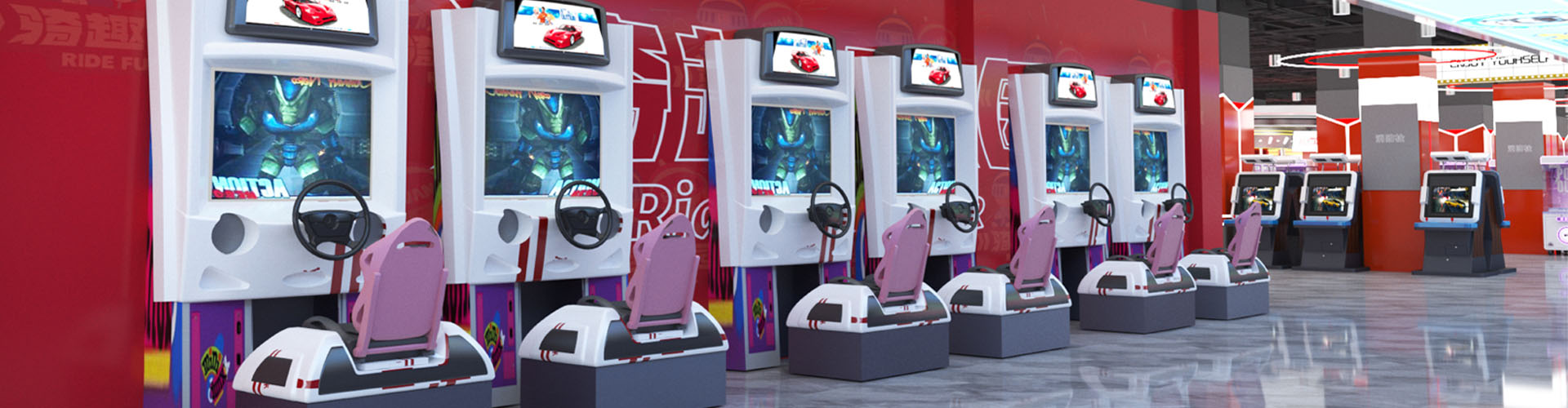
Anyone comparing machines for a family entertainment center eventually asks the same question: what actually separates the best tabletop arcade machine from a shrunk-down upright with a smaller screen bolted on top? The answer has less to do with graphics and more to do with cabinet geometry — how the unit is shaped, where players stand, and how that shape changes the way two people play together.
The cocktail-style cabinet is one of the oldest formats in arcade history, built decades ago for cafes and bars where players sat rather than stood. The Pac-Man Coffee Table Arcade Machine revives that format for a different purpose: seating a parent and a child across a flat glass screen instead of lining them up side by side.
That single design choice matters more than it looks. Facing each other changes the social dynamic of the game. It turns a solitary reaction-speed challenge into something closer to a shared table game, which is the entire point of a two-player parent-child unit.
For venue operators, cabinet shape is only half the story — the physical footprint decides where a machine can actually go. This model measures 1.23m in length, 0.58m in width, and 0.78m in height, closer to a coffee table than a cabinet.
| Specification | Value |
|---|---|
| Player Capacity | 2 people |
| Machine Size | L1.23m × W0.58m × H0.78m |
| Machine Weight | 60kg |
| Power Requirement | 220V/110V |
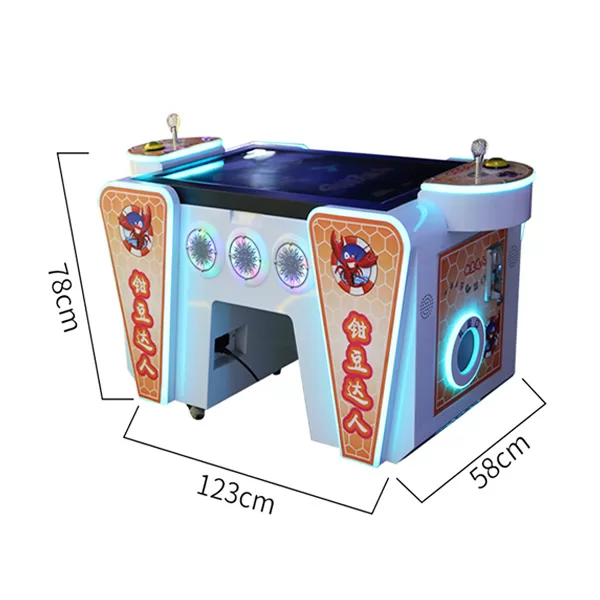
A 60kg unit at this footprint fits waiting areas, parent-child zones, and cafe corners where a full upright cabinet would never be approved by a venue manager watching square footage.
Two joysticks mounted on opposite sides of one flat screen force a specific kind of coordination. Each player reacts to the same visual field from a different physical angle, which is a small but real difference from mirrored side-by-side cabinets. That geometry rewards quick visual tracking over memorized muscle movement, which is exactly why simple joystick-and-button layouts work better here than complex control schemes. For a child still building hand-eye coordination, and for a parent playing alongside rather than instructing from outside, that layout is doing more engineering work than it appears to.
Specification sheets for this category often list two different wattage figures, and that is not a printing error. Circular LED accent rings and the glass-covered display draw very little current while idle, but active gameplay — screen refresh, lighting animation, and any prize-dispensing motor — pushes draw noticeably higher. That is why a unit like this can show a lower idle figure alongside a higher active-load figure; both describe the same machine at different moments. Operators should size circuit capacity around the higher active figure, not the idle one, and confirm local voltage against the standard 220V/110V requirement before installation.
This format is not trying to replace a full arcade hall centerpiece. It is built for a narrower set of venues:
Some configurations also dispense gashapon capsules or tickets after gameplay, which adds a small reward loop without changing the cabinet’s core footprint or power requirements.
Does a compact tabletop cabinet mean weaker gameplay than a full-size upright?
Not necessarily. Screen size affects visual immersion, but a tabletop unit built around two-player interaction is optimized for accessibility and shared play, not for the depth expected from a competitive arcade cabinet. The two formats are solving different problems.
Is a 60kg cabinet sturdy enough for continuous public use?
For a unit this size, 60kg generally indicates a reinforced internal frame rather than a lightweight shell, which is consistent with equipment meant for repeated public handling rather than home-only use. Confirming warranty terms and after-sales support with the supplier remains the more reliable check than weight alone.
Choosing among tabletop cabinets ultimately comes down to matching footprint, power draw, and player ergonomics to the venue itself, rather than chasing the highest spec sheet. For operators weighing options, the practical test of the best tabletop arcade machine is whether it fits the space, the audience, and the daily power load — and that is the standard we build toward for us.