
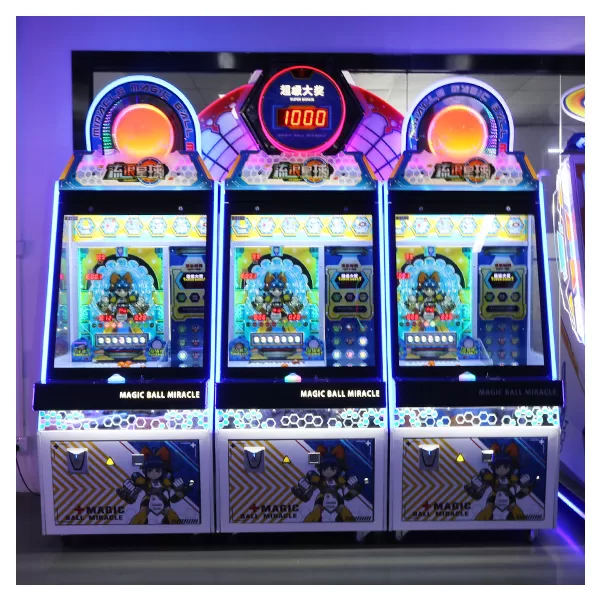
Anyone shopping for an arcade ticket machine eventually asks the same question: is the “skill” part real, or just a marketing label on a machine that’s actually random? The Magic Ball Miracle, a three-player ticket redemption cabinet, is a good case study because its entire payout logic rests on one moving part — a pointer that dictates when a ball launch actually counts. Understanding that mechanism tells you more about fairness and profitability than any spec sheet alone.
Operators don’t actually worry about whether a game feels flashy. They worry about repeat play. A machine that pays out too easily drains ticket stock and margin. One that pays out too rarely gets ignored after a week. The pointer timing system in this cabinet exists to sit in the narrow band between those two failure states.
The mechanism works like this: a pointer sweeps across a set of scoring holes, and the player presses a button to launch a ball at the moment they judge the pointer’s position. Hit the timing window, and the ball drops into a higher-value hole — white pearls, large balls, or on rare attempts, the path toward the super grand prize.
This is not a coin pusher dressed up with lights. The reaction-timing input means outcomes shift with practice, which is the defining trait of a genuine skill-based redemption category rather than a pure chance device.
Here’s the part most buyers overlook. A pure chance machine has a fixed statistical payout regardless of who plays it. A timing-based machine has a payout curve that bends with player skill — a first-time player and a regular customer will not hit the same hole frequency. That’s precisely why operators can tune ticket output through prize scarcity rather than rigging odds, keeping the game legally and practically closer to a skill contest.
For players, this shows up as a sense of improvement over repeated visits. That sense of “I’m getting better at this” is what keeps a redemption machine earning past its first month on the floor, unlike novelty machines that get played once and abandoned.
Because three people play at once, the cabinet’s physical footprint matters as much as its game logic when planning floor layout. Below is what operators typically need to check before placement:
| Spec | Value |
|---|---|
| Player capacity | 3 people |
| Machine dimensions | 2.45m (L) x 0.93m (W) x 2.48m (H) |
| Machine weight | 400 kg |
| Power consumption | 800W |
| Voltage | 220V / 110V |
| Shipping weight | 160 kg |
An 800W draw and dual-voltage support mean the unit can generally run on standard commercial circuits in most regions without a dedicated line, though venues with several large cabinets running simultaneously should still confirm total circuit load with an electrician.
A single-player skill game is a queue generator. A three-player unit is a social anchor. That distinction drives where this type of cabinet actually performs:
The 2.48m height and dome-style ball display also make it a visual anchor from across a room, which matters more for foot traffic conversion than most operators initially budget for.
Does timing skill really affect the odds, or is it mostly for show?
The pointer’s speed and hole placement are fixed by the machine, but the launch moment is entirely player-controlled. Repeated play measurably improves hit rate, which is the standard definition of skill-based redemption used across this equipment category.
Can operators adjust how often the grand prize triggers?
Ticket redemption machines in this class typically allow prize-tier adjustment through settings rather than altering the physical timing mechanism, letting operators manage payout cost without changing how the game plays for the customer.
Choosing an arcade ticket machine ultimately comes down to whether its core mechanic rewards attention or just luck. For us, that distinction shapes every cabinet we test in our own operating locations before it ever reaches a client’s floor — because a redemption game only earns its space if players keep coming back to beat their own last score.